









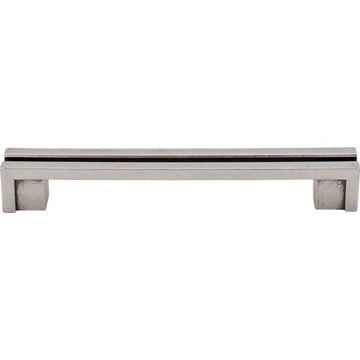

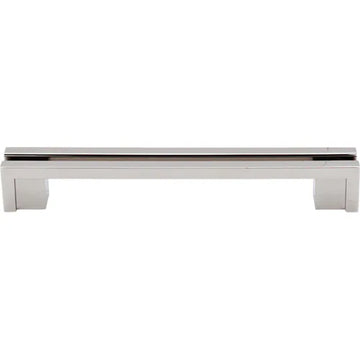

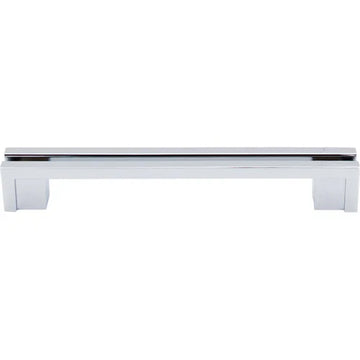
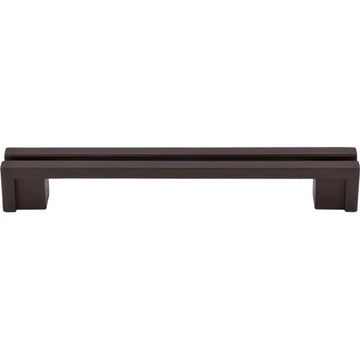

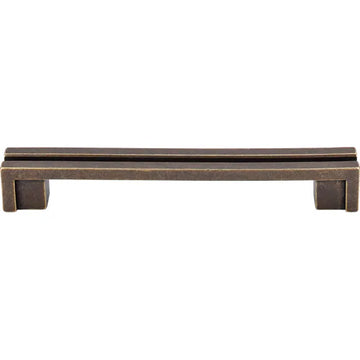

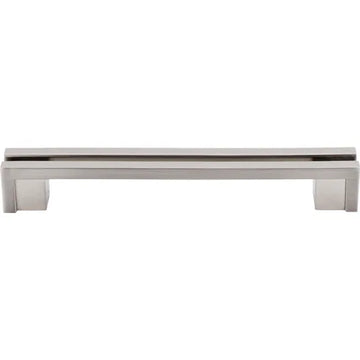


Straight pulls for clean cabinet lines
Straight pulls are cabinet pulls whose grip runs in a single linear axis from mount to mount. The defining trait is the absence of curve along the grip — the line stays flat between the two fixing screws. Within that family sit bar pulls, square-ended bars, wire pulls, and slim-profile contemporary pulls. Each one delivers a horizontal line across the cabinet face and reads cleaner than any curved silhouette.
When a straight pull is the right call
Modern, contemporary, transitional, and industrial kitchens almost always reach for straight pulls. The shape matches the rectilinear geometry of slab-front and frameless cabinetry and lets the cabinet face stay the visual subject. Shaker kitchens read more traditional with a slightly profiled bar (rounded ends rather than square cuts). Heavy ornamental kitchens tend to read better with curved or cup pulls instead; a straight pull on a fluted Tuscan door front fights the door.
Length and drill spacing
Length on a straight pull is read as both the overall span (mount-edge to mount-edge) and the center-to-center drill spacing. The two numbers track loosely. A 5-inch pull might use 96mm (about 3.78 inches) centers, with about half an inch of finished length past each screw. For upper cabinets, 3- and 4-inch centers suit the smaller drawers; base cabinets and trash drawers usually take 5- to 7-inch centers; appliance panels go longer still. Look for sample boards or printable templates before drilling.
Where to go from here
Within the straight family, the round-section bar pulls read softer than the square-section pulls; wire pulls read the lightest of all. For a slight curve away from pure straight, see bow pulls and arch pulls — both add character without committing to ornament.
Frequently Asked Questions
What is a straight pull and how does it differ from other cabinet pull types?
A straight pull is a cabinet pull whose grip runs in a single linear axis between two mounting screws, with no curve along the grip surface. This distinguishes it from bow pulls and arch pulls, which introduce a gentle curve, and from cup pulls or bin pulls, which are recessed into the cabinet face. Within the straight pull family there are sub-types — bar pulls, square-ended bars, wire pulls, and slim-profile pulls — but all share the defining flat, horizontal line across the cabinet face.
What cabinet styles and door fronts are straight pulls best suited for?
Straight pulls pair most naturally with modern, contemporary, transitional, and industrial cabinetry, particularly slab-front and frameless door styles where the rectilinear geometry of the pull matches the geometry of the cabinet face. Shaker-style kitchens can work with a slightly profiled bar pull — one with rounded rather than square-cut ends. Heavily ornamental door fronts, such as fluted or raised-panel Tuscan styles, tend to read better with curved or cup pulls, because a straight pull's linear profile conflicts visually with the door's ornamental lines.
How do straight pulls compare to bow pulls for everyday cabinet use?
Both straight pulls and bow pulls mount with two screws at the same center-to-center spacing, so they are largely interchangeable in terms of installation. The practical difference is visual and tactile: straight pulls project a flat, uniform horizontal line that keeps the cabinet face as the visual subject, while bow pulls arc outward between the mounts, adding a subtle curve that introduces more character without committing to full ornament. Straight pulls read cleaner in modern and slab-front applications; bow pulls soften the look for transitional or Shaker contexts.
How do you choose the right length and drill spacing for a straight pull?
Straight pull sizing involves two related measurements: overall length (mount-edge to mount-edge) and center-to-center drill spacing, which is the distance between the two screw holes. A 5-inch pull, for example, commonly uses 96mm (approximately 3.78 inches) center-to-center spacing, with roughly half an inch of finished bar extending past each screw. As a general guide, 3- to 4-inch centers suit upper cabinet drawers, 5- to 7-inch centers suit base cabinets and trash drawers, and appliance panels typically call for longer pulls. Using a sample board or printable template before drilling helps confirm the sizing against the actual drawer front.
What Customers Say
Trusted by thousands of designers, builders, and homeowners
Kayla Malo is the most attentive and super human ever! My experience with this company is stellar!

Love working with Kayla, she is extremely helpful and quick with responding to my questions!
Kayla was GREAT!!!! Super help and fast answers. One of the best I've ever dealt with.